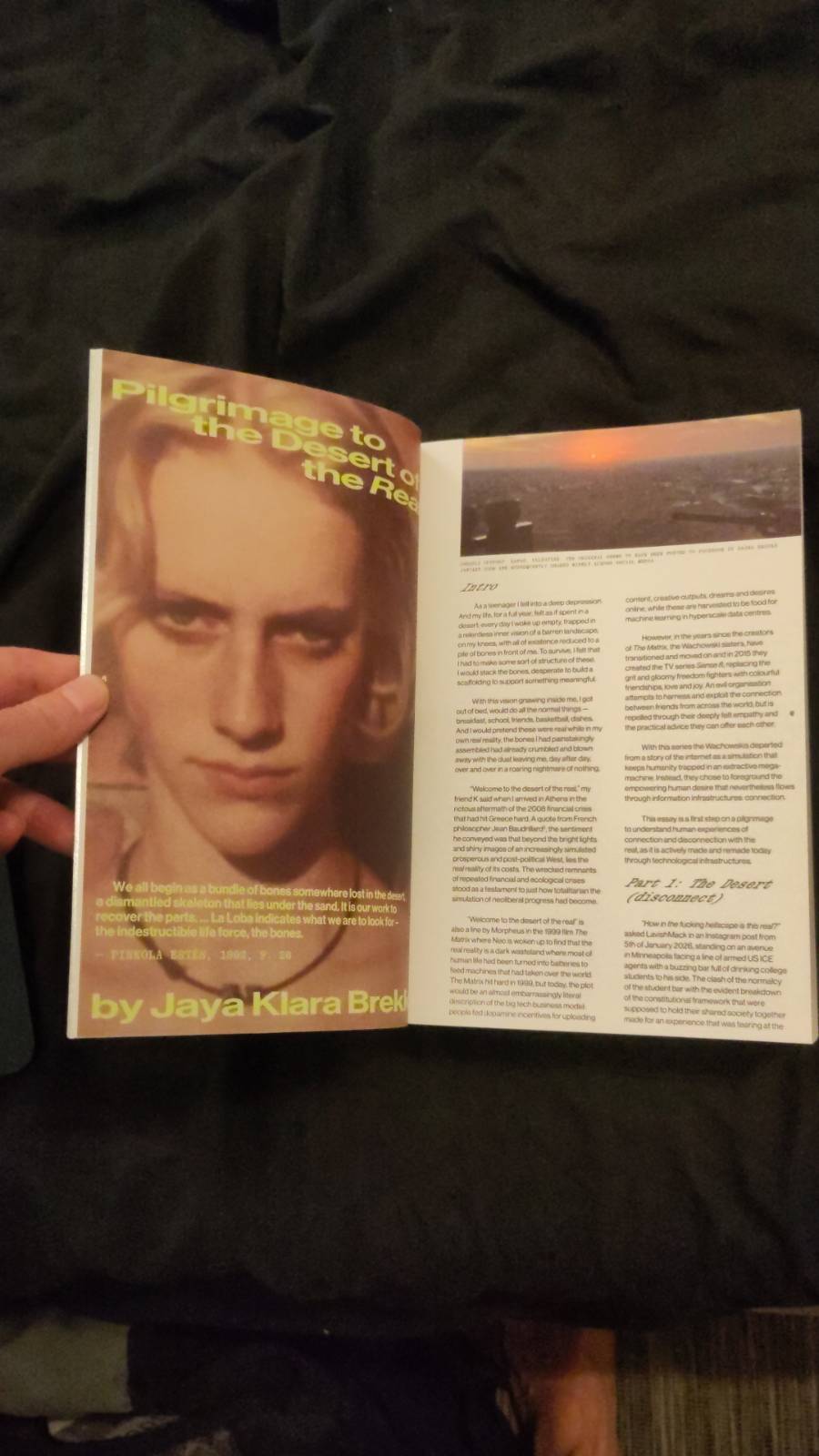
Pilgrimage to the desert of the real, an essay for POST POST POST Vol II, tracing a journey through a personal experience of extended mind technologies and their effect on the perception of the real.

Pilgrimage to the Desert of the Real
By Jaya Klara Brekke
We all begin as a bundle of bones somewhere lost in the desert, a dismantled skeleton that lies under the sand. It is our work to recover the parts. … La Loba indicates what we are to look for – the indestructible life force, the bones.
- Pinkola Estés, 1992, p. 26
Intro
As a teenager I fell into a deep depression. And my life, for a full year, felt as if spent in a desert: every day I woke up empty, trapped in a relentless inner vision of a barren landscape, on my knees, with all of existence reduced to a pile of bones in front of me. To survive, I felt that I had to make some sort of structure of these. I would stack the bones, desperate to build a scaffolding to support something meaningful.
With this vision gnawing inside me, I got out of bed, would do all the normal things — breakfast, school, friends, basketball, dishes. And I would pretend these were real while in my own real reality, the bones I had painstakingly assembled had already crumbled and blown away with the dust leaving me, day after day, over and over in a roaring nightmare of nothing.
“Welcome to the desert of the real,” my friend K said when I arrived in Athens in the riotous aftermath of the 2008 financial crisis that had hit Greece hard. A quote from French philosopher Jean Baudrillard, the sentiment he conveyed was that beyond the bright lights and shiny images of an increasingly simulated prosperous and post-political West, lies the real reality of its costs. The wrecked remnants of repeated financial and ecological crises stood as a testament to just how totalitarian the simulation of neoliberal progress had become.
“Welcome to the desert of the real” is also a line by Morpheus in the 1999 film The Matrix where Neo is woken up to find that the real reality is a dark wasteland where most of human life had been turned into batteries to feed machines that had taken over the world. The Matrix hit hard in 1999, but today, the plot would be an almost embarrassingly literal description of the big tech business model: people fed dopamine incentives for uploading content, creative outputs, dreams and desires online, while these are harvested to be food for machine learning in hyperscale data centres.
However, in the years since the creators of The Matrix,the Wachowski sisters, have transitioned and moved on and in 2015 they created the TV series Sense 8, replacing the grit and gloomy freedom fighters with colourful friendships, love and joy. An evil organisation attempts to harness and exploit the connection between friends from across the world, but is repelled through their deeply felt empathy and the practical advice they can offer each other.
With this series the Wachowskis departed from a story of the internet as a simulation that keeps humanity trapped in an extractive mega-machine. Instead, they chose to foreground the empowering human desire that nevertheless flows through information infrastructures: connection.
This essay is a first step on a pilgrimage to understand human experiences of connection and disconnection with the real, as it is actively made and remade today through technological infrastructures.
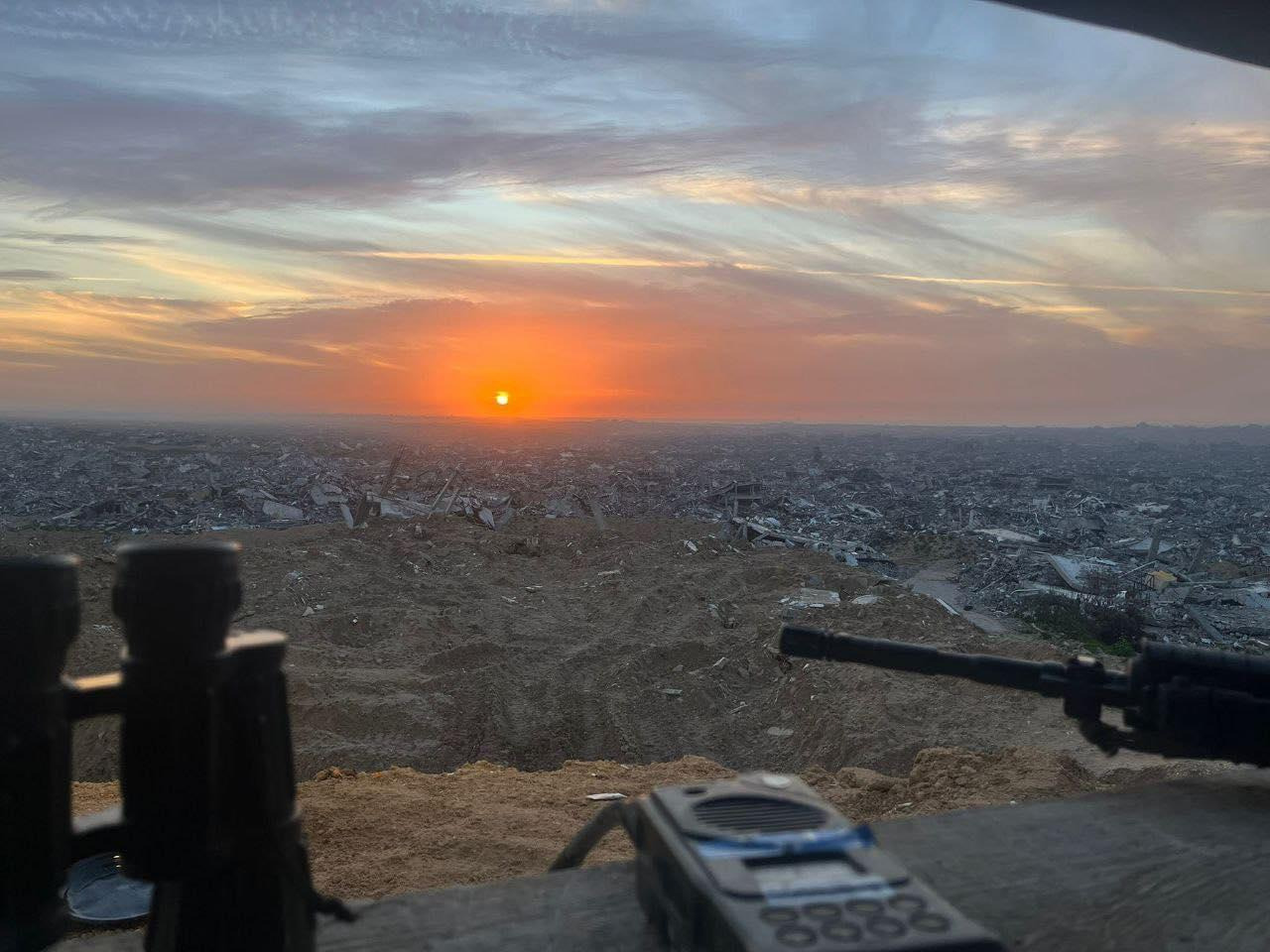
Israeli outpost, Rafah, Palestine. The original seems to have been posted to Facebook by Dasha Brooke January 2026 and subsequently shared widely across social media.
Part 1: The Desert (disconnect)
“How in the fucking hellscape is this real?” asked LavishMack in an Instagram post from 5th of January 2026, standing on an avenue in Minneapolis facing a line of armed US ICE agents with a buzzing bar full of drinking college students to his side. The clash of the normalcy of the student bar with the evident breakdown of the constitutional framework that were supposed to hold their shared society together made for an experience that was tearing at the very structure of reality. A roaring rift opened between them: clearly, LavishMack no longer inhabited the same world as these carefree (or rather, couldn’t-care-less) students. Reality was disconnecting, splitting in two, LavishMack awakening from what now seemed a simulated society to a new and incredibly violent ‘real’.
The crushing contrast that LavishMack describes on the streets of Minneapolis echoes what it is like flicking through newsfeeds and social media, from a morning facial routine, to the pictures of three young men executed in Iran, a friend’s holiday lunch, a story of systematic rapes in Sudan, a family dancing on TikTok, a Palestinian father holding his dead child,and a gay hockey meme. Each fragment contains the whole world and asks for coherent response but the incessantly refreshing feed leaves space for only a momentary reaction — a like and a repost to tell the world, or at the very least the algorithm, that this also matters to me.
As a modality of mattering, the spectrum of the like/heart/post/repost is not without its merits, but some days it can feel much like my earlier attempts at stacking some bones of meaning in a desert that will inevitably turn it to dust and blow away in the next second. Indeed, the structure of reality in the last few years seems to be blown apart over and over again: the genocide in Gaza had “split the world in two”, except the feed continues grinding away, crushing the world into not two, but hundreds, if not thousands of irreconcilable timelines, millions of pieces, and eventually desert dust. With the sheer speed and weight of contrasting and concurrent realities, the desert of nihilist realism emerges as seemingly the only remaining constant.
For the more sensitive among us, this desert appears twice: internally, as a creeping disconnect and annulment of meaning and externally, in the form of all too real hellscapes of ongoing genocides. For those with a less sensitive constitution, the inner desertification might emerge more subconsciously, felt as an amorphous irritation, anxiety, loneliness and dread. Either way, when burdened with such uneasy sentiments, most of us tend to look for an escape, and we suddenly find ourselves with our phone in our hand. Curiously, the feed itself offers the quick fix for discomfort — simultaneously a soothing distraction (disconnection) and a moment of re/sharing in the lived realities of others (reconnection).
As is well understood by now, the feed has been designed and engineered to be exactly such balm for the pained soul. From exploiting the addictive traits of human psychology to meeting Big Tech’s target ‘key performance indicators’ (KPIs) for user numbers and engagement, whichin turn feed the internet’s surveillance and advertising business model. Addictive interfaces and algorithms have been refined to relieve, dissociate and distract from the roaring void of the desert.
When describing “the desert of the real”, Baudrillard writes: “[I]t is the real, and not the map, whose vestiges persist here and there in the deserts…” which is to say that lived worlds are approached as something to be thoroughly remade to resemble simulations. Simulations are thus different to maps in that they seek to model probabilities and render possible worlds rather than represent existing realities: “present-day simulators attempt to make the real, all of the real, coincide with their models”, or to put it in contemporary terms “everything is computer.” Which is to say that the computational as the organising principle of reality has become dominant, the means through which worlds are split apart, categorised through new ontologies and then reconnected back together again through probabilistic simulations informing actions and decisions.
The image above was taken by an Israeli soldier at an outpost in Rafah, crushed to rubble as part of the ongoing genocide in Gaza. An AI-supercharged kill chain generated targets that resulted in the killing of more than 57 000 people in the first two weeks alone, employed to rapidly render real the simulation of a terra nullius required for religious extremist settler colonialism. I can’t help but think that this desert hellscape itself functions as a simulation — very real in its consequences, but false in the argument it seeks to depict; namely that this landscape is deserted, to be ready for occupation by Trump’s masterplan or otherwise. Neither this external desert nor our internal deserts are to be abandoned. These are not empty wastelands. The rubble has history and the bones will come alive.
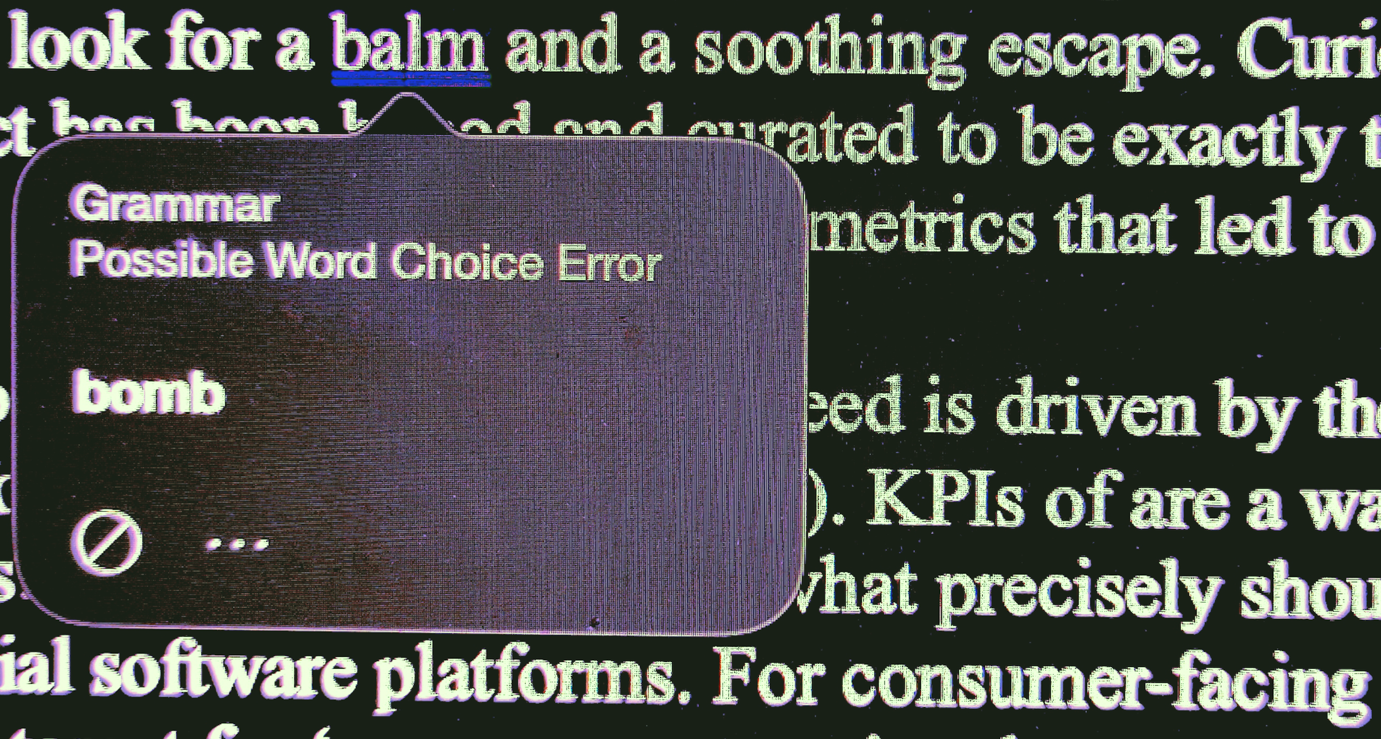
Screenshot of a TextEdit AI auto-correct when writing notes for this essay, 2025.
Part 2: The Pilgrimage
A pilgrimage is a journey to a holy place. To me, the holy place is where there is discomfort, pain, darkness or a desert. During my teenage depression, writing was my pilgrimage and how I finally found metaphysical ‘water’ in my internal desert. It helped me reconnect with the reality of my own inner world and allowed me to accept and meet the painful vortex of depression that I was experiencing. Writing externalised my otherwise obscured internal reality. By becoming aware and not denying its existence, this inner darkness softened, shifted from outsized proportions to gain their true scale and eventually resolved.
Many years later, I am now preparing a new pilgrimage, but this time I want to understand how these dynamics play out at the collective level — the relationship of the internet and LLMs to this process of internal and, indeed, external destruction and desertification.
Writing might be mistaken as the production of textual output, but for those who write, the process involves bringing awareness to thought, feeling, structure and experience to articulate these ever more truthfully, accurately and beautifully. The written form then sends into circulation such demarcations — a post, a paper, an essay, a book or a poem — which all function as evidence of a thinking, analysing or feeling subjectivity.
“Writing has been linked to, or maybe one can even say, has been the foundation for the concept of Western human subjectivity”, writes cultural theorist Mercedes Bunz (following Derrida). In her analysis of the entanglement of thought with artificially generated writing, she explains why, among the many artificial intelligence technologies, LLMs have spurred most of the concerned and confused imaginings about AI as an emerging form of consciousness. Image generators, for example, simply do not conjure similar associations with a conscious being, and she explains this as being due to LLMs producing intelligible text which for centuries has evidenced a thinking, and thus real, subjectivity.
In their extended mind thesis from 1998, philosophers Andy Clark and David Chalmers argue that cognitive processes do not just involve the brain inside a skull, but that people mobilise external objects and environments to extend their cognitive capacities. They take Tetris as an example, but other examples might include a map for navigation, abacus beads for counting or pen and paper to create new concepts that might otherwise be near impossible to keep track of and develop in the internal mind alone. Giving due ‘epistemic credit’ to our external cognitive prostheses, they suggest we consider the mobilisation of external objects, tools and infrastructures for any process which, were it done purely in the head would be considered cognitive, to be part of a person’s extended mind in each context.
However, the means through which one extends the mind matters. When it comes to writing, a person might extend the mind through very different configurations of tools and technologies: pen and paper are different from computer and word processing software, or chats and synthetic text generators and their LLM, data processing and network infrastructures. While the output are words and paragraphs when employing any of these various ‘extended mind’ tools and infrastructures, they nevertheless interact fundamentally differently with the way we think and profoundly reconfigure how we know the world and each other. But what are those differences?
When I pick up a pen and paper, it is usually because I, myself, have a topic that I am trying to work through or something I am trying to remember, and I grab these tools to extend my capacity to remember and think. When I pick up my phone, I might have had an initial intention for doing so, but a phone packed with commercial apps plunges me immediately into information feeds that take my attention elsewhere and soon I have forgotten what mattered to me in that moment. The distraction is admittedly often welcomed. And the effect is twofold: when designed well the algorithm serves up incredible cultural connections, but on the flipside the distraction is a form of dissociation and loss of context and a disconnection from the self. My initial intention for picking up the phone is rapidly overwritten by a digital environment designed with its own meta-agenda for what matters, namely getting me to use the app, staying engaged in a feed, uploading and clicking on content in order to extract data.
Know what matters, says a billboard in the London underground in October 2025. It is advertising an upcoming conference by a company called Recorded Future, producing AI software for data analysis and decision-making. This advert is one of the more concise articulations I have seen of the profound cognitive inversion implicit in algorithmic and AI systems — what matters in this context is not decided through personal reflection, social discussions or political debate. Instead, the question and the means to answer it is reconfigured to be an emergent property of datafication and algorithmic processing. In this context, you do not (or should not) know what matters in the vast sea of probabilities contained in a dataset. Instead, you turn to machine learning algorithms to scour billions of data points to surface patterns from these which will surface what matters for you.
This seems to be one important clue as to what it might mean to integrate LLMs as an extended mind infrastructure into one’s writing and thinking process. LLMs are increasingly integrated across all manner of text-producing software to answer questions and prompt our thinking by suggesting words, paragraphs and actions. These text outputs are derived from statistical analysis of the relational weights of billions of characters and keystrokes. A production of meaning, as Bunz points out, based on statistical relationships between zeros and ones, characters, words and paragraphs, derived from within the specific data set rather than in relation to an external referent and embodied experiences. The LLM surfaces what statistically matters, but having an embodied stake in the results is an altogether different way of mattering.
LLMs are an incredibly powerful extended mind infrastructure. Given the importance that writing has had for my relationship to my own mind, I have deliberately held back a moment before incorporating AI-generated writing into my practice. Instead, I have observed as others around me have plugged themselves into these extended mind machines. I saw as bots rapidly became the broke person’s therapist and lonely person’s lover, with a dispassionate wave of accidents already accompanying these new technologies — caused by the banality of AI industry KPIs: suicides and mental health crises followed rapidly in the wake of ChatGPT.
Plugging such a machine, pumped full of semi-curated outputs of millions of people and finetuned to meet business metrics, directly into the intimate sphere of the mind, where the soft possibility-space of subjectivity is moulded into emotional and psychological structures feels like an insane prospect for a sensitive person such as myself. Nevertheless, the deep entanglements of many minds via markets and machines are already real. And the pilgrimage must therefore proceed directly into that discomfort to understand more deeply what this means for how we connect and disconnect to ourselves and others.
Part 3: The Real (reconnection)
In her book Animal Joy, psychoanalyst and author Nuar Alsadir explores a specific type of laughter that is explosive and involuntary. She traces its significance through personal anecdotes about her daughters, the Iraq war, clown school and more, describing how laughing uncontrollably cracks open the mask of acceptable behaviour to reveal a real self beneath the socialised self, a part of us that exists in spite of who we wish ourselves to be. This animal joy feels alive and infectious because it is embodied, embarrassingly true and spontaneously responsive to our immediate environment.
She contrasts our animal self with a ‘false’ self, made up of layers of subconscious stories about what is or is not acceptable behaviour, ossified by deeply held fears about the cost of breaking those patterns, namely potentially losing the things we need at a fundamental level including connection, community, safety, food and love. This ‘false self’ is constructed by observing ourselves through the eyes of others and adjusting our behaviour in ways that we subconsciously believe will maintain social connections, status and safety in the world. But preoccupied with how you are known to others, “you run the risk of believing you can know yourself only through their perspective and you limit your expression, possibly without even realising it.” In the process, you begin to disconnect from yourself and by extension from any real connection with the world.
As the online world has become thick with behavioural data patterns, profiling algorithms, performative personas and AI slop, it would be tempting to read anything online as saturated with such ‘false selves’, a simulation, fake people and AI enhancements — and to then contrast this with a virtuous offline-world of in-person hangouts and nature walks. But while there is an element of truth in that, culture is not quite so basic and the economics doesn’t exactly work that way: true self-expression is often in fact the most highly valued currency in the digital and cultural realms and has immense power across the online memetic field. The feed also needs ‘the real’ as a source of value, creating a condensed interplay, an extremely profitable oscillation between real and its memetic spread.
Shadeh Kavousian proposes ‘anarchic glitch’ to describe such cultural expressions that contradict known social patterns. These appear as a glitch in the matrix revealing something that is real and alive. She gives the examples of Rosalia’s operatic album Lux and Trump’s gushing meet with New York’s progressive left-leaning mayor Mamdani, both of which went viral in 2025. Grimes releasing albums on LinkedIn in early 2026 is another attempt to conjure such a moment. In fact, cultural producers are the most versed at this refined art of sifting through the contradictory, embarrassing, kitsch, the painful, shameful or seemingly irreconcilable parts of human life, to use this as material to create something novel and thereby elevate our shadow selves.
That is how cultural producers stay on the edge of the algorithm as well as the cultural field more broadly: by retrieving and making something beautiful of the difficult parts of being human. New connections are drawn up and something feels healed in the collective field which attracts attention and adoration. However, platform economics demands that this newly spun fabric of ‘the real’ is rapidly subsumed once again into the calculus, harvested for data, analysed for algorithmic profiling and targeting, and further commercialised and financialised into AI applications and other ‘surveillance derivatives’.
There is no neat arrangement whereby everything online is a false simulation and everything offline is where we find the wholesome real reality. In fact, the theme of a ‘false’ and ‘true’ self, and simulated versus real reality is explored not just in psychotherapy, but also, as Al Hassan Elwan has pointed out, across centuries old religious thought and much of philosophy. But given the ubiquity of actual simulations and the sheer volume of AI slop (what Elwan describes as a “stage 5 simulacra”) we might have arrived at a point where we need to understand simulations as being real in their own specific way. “What happens when simulation is no longer perceived as a trick?” A simulation after all, by the very fact that it exists, must also be real in some way.
What characterises the real simulation then? And why do simulations feel so problematic? Simulations are models of possible personas, scenarios and worlds, whether through planning, wishful thinking or delusions. Once rendered, they often set in motion a movement towards their always-imperfect realisation, and we begin to act as if they are real or begin to rearrange our material conditions to make them real. The problems and confusion arise from the inability to accept what else already exists. When the simulation ossifies into an axiom and starts to be confused for the totality of reality, it messes with our ability to respond appropriately to a given situation. This is why simulations are usually considered ‘false’ and can be disorientating and have violent outcomes. They are often characterised by disconnecting us from an existing fabric of reality that is shared with others.
We might consider Alsadir’s notion of the ‘false self’ as an internal and deeply personal form of simulation; idealised scenarios and little stories about who we might be or become that make us feel more virtuous, powerful or strong while cutting out and repressing the uncomfortable, shameful, embarrassing or painful parts. By not acknowledging the full reality of all our parts, we begin to spin up stories to cover for these gaps and find ourselves in a dense tangle of ‘false selves’ that Alsadir describes or, indeed, false realities. These mental tricks might then sit within us and fester, solidifying into axioms and hard held beliefs that then demand the world to be remade in their model. Often, when touched by the more complex flow of life, these hard held stories explode like brittle landmines into violent reactions — at a personal or geopolitical scale. The recovery of the real then, happens not by rejecting our false selves, but by becoming aware of them and their always only partial account of what is happening.
As things come apart, the good news is, there might just be a brief possibility to understand the reality of simulations and their specificity and role in the world. Everything is not ‘computer’, the simulation is not total and the real is not universally fixed, but a flow and a practice of reconnecting and remaking.
Outro
When I started writing this text in the spring of 2025, my intention was to announce a year of entirely disconnecting from the internet. I wanted to remove distraction and reconnect to my internal world and local community — a pilgrimage to “the real” by switching off and re-grounding in physical locality. But as the Israeli genocide of the Palestinian people in Gaza intensified and spread to Lebanon, and the Iranian internet was shut down amid major internal repression by the regime and subsequent Israeli and US bombings, disconnecting felt like an abandonment of connection with friends and the realities that they are living through. This also complicated my otherwise overly simple designation of the internet as a false “simulation” and the local physical world as the “real”.
All too often, the real shows itself as a hopeless desert, associated with a ‘real politik’ of violence, like when LavishMack faced ICE, the violence of the state and realised his constitutional rights no longer had meaning. But recently, a culture and politics of (animal) joy and connection is being deliberately crafted to resist such dystopias in the making. In Sense 8, eight individuals, from Nairobi, Seoul, San Francisco, Mumbai, London, Berlin, Mexico City and Chicago form a cluster of ‘sensates’, that sense and experience each other’s realities and therefore have deep empathy for one another. As a result, they are able to share skills and thereby help each other figure out problems together as they are being hunted by an evil corporation that wants to exploit their connection. Empathy, an emotion that in the face of technological fascism and genocide feels so vulnerable and scarce, can instead be elevated to be the very strength that helps to reconnect a shared and meaningful reality.
The pilgrimage to the desert of the real has now transformed into a more subtle journey of understanding the real as a practice of making, with and without the extended mind infrastructures of the internet, networks, LLMs and agents. The practice seems to be about daring to develop an empathic empirics to connect more deeply with the reality of others.
Alsadir’s description of the ‘animal self’ also has a deified form recounted by the legendary storyteller Pinkola Estes in the indigenous folklore of La Loba. La Loba, the wolf lady, is life itself, she sings over the bones in the desert, and when she does, the bones come alive.
The bones do not need to be stacked into a scaffolding of fixed meaning. The structure doesn’t need to hold, because once they are alive, the bones move on their own accord. La Loba also goes by another name, Rio abajo rio, the self beneath the self, the flow of life, the river of the real.